
Educational comparison for U.S. pet owners. Dollar examples are invented; offered contracts and state rules determine coverage and obligations. This guide does not recommend a particular policy.
You want help with the vet bills. Then three different offers appear: insurance, a wellness plan and a suggestion to build savings. All can involve putting money aside or paying each month, so it is easy to wonder whether they are different names for the same thing.
They are different—and understanding how they work can make it easier to choose one, combine them, or decide what you can comfortably handle yourself.
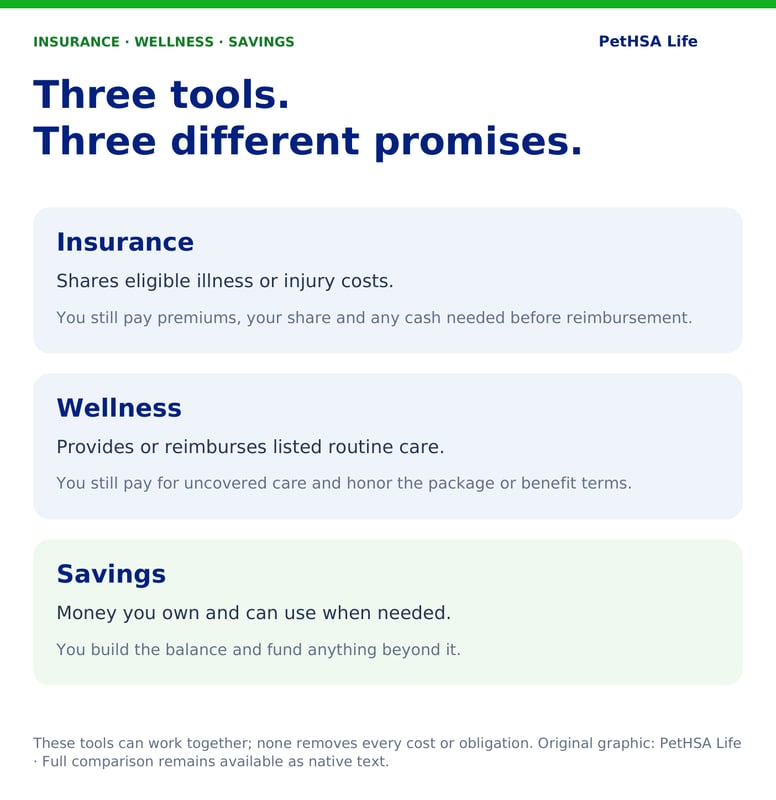
Insurance can share the cost of eligible illness or injury. A wellness arrangement pays toward, or provides, listed routine services. Savings are money you own and can use when needed, up to the balance available.
You can combine them, but you do not need to buy every product to be a responsible pet parent. Start with the problem you want help solving: a large surprise bill, predictable care through the year, or having cash ready when the practice needs payment.
Jump to: Insurance · Reimbursement example · Wellness plans · Savings
Three tools, three different promises
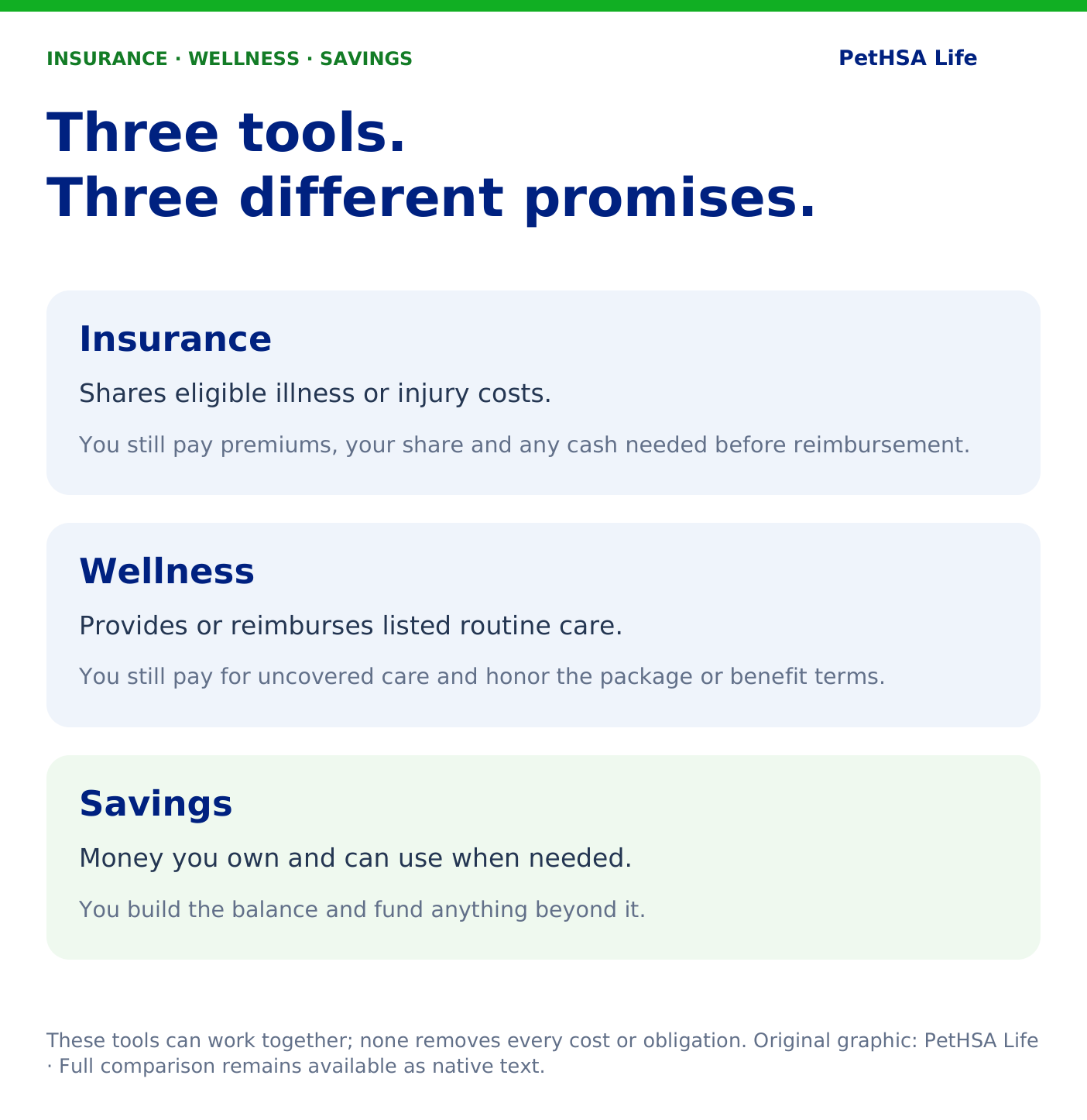
Figure text and data
Insurance shares eligible costs; wellness provides listed routine benefits; savings is money you own. Each leaves different costs and obligations to the owner.
Tool | What you are paying for | What remains your responsibility
Accident or accident-and-illness insurance | Contractual payment toward eligible care, subject to the selected coverage | The price of the policy, the portion of bills left to you and any cash needed before reimbursement
Wellness benefit or service package | Listed routine-care reimbursements or services, according to the arrangement | Payments, amounts beyond benefits, unused services and contract obligations
Savings | A balance of your own money that you retain until you spend it | Building the balance, deciding how to use it and funding any shortfall
Original graphic: PetHSA Life · Figure text and data.
PetHSA Life editorial guide; use your pet’s needs and the applicable terms.
For example, paying into a wellness package will not normally provide the same protection against an unexpected operation as an accident-and-illness policy. Insurance, in turn, may leave routine care to you. Your own savings can cover either kind of expense, but only as far as the money stretches. The useful choice is the one that addresses the gap you actually have.
How pet insurance works, in everyday terms
You pay an insurer a premium: the price of keeping the policy in force, usually paid monthly or annually. In return, the insurer agrees to help pay for veterinary expenses covered by that policy. Premiums buy coverage; they do not build a personal savings balance. That exchange is set out in the insurance agreement.
When your pet receives care, a claim asks the insurer to pay its covered share. The insurer reviews the bill and any required records. It then applies the policy’s rules to determine what it owes. A covered illness does not necessarily make every item on the invoice eligible.
Four terms explain much of what happens next:
- Deductible: the amount of eligible costs left to you before the policy begins paying. You may meet it through earlier claims or partly or entirely through the current bill. If eligible costs have not reached it, the policy may pay nothing yet. Paying the premium does not satisfy the deductible.
- Reimbursement percentage: the share the insurer pays of the amount its formula applies to. An 80% rate does not necessarily mean 80% of your entire invoice.
- Limit: the most the policy will pay within a stated period or category.
- Exclusion: a condition, service or other expense the policy does not cover.
The California insurance regulator’s question checklist helps you check those terms against an actual quote. For a deductible, ask which charges count toward it and how much remains—not just how large it was when you enrolled.
This explains the difference from saving alone. An eligible insurance payment can exceed the premiums you have paid, while your savings are limited to the balance you have built. Insurance can therefore help with a large covered bill before you have accumulated a large savings reserve. That protection still depends on coverage being in effect, any applicable waiting period having ended, and the deductible, exclusions and limits.
There is another practical difference: most pet policies work by reimbursement. With this arrangement, you pay the veterinarian first and receive the insurer’s payment later. Even a covered event can require savings, available credit or a confirmed direct-payment arrangement at the clinic. Having coverage and having money available at checkout solve different problems.
The premium remains an expense even in a year with no claim. A household may value protection against a large eligible bill without expecting to recover every premium. Another may have substantial savings or find that the offered policy excludes its main concern. Neither choice measures how much someone loves their pet.
What would “80% back” mean on your bill?
Start with the bill, then separate what the policy covers from what it does not. Only then apply the deductible and reimbursement rules.
Illustration — invented amounts. Imagine a $2,000 vet bill. The policy covers $1,800 of the charges and excludes $200. It pays 80% after subtracting the remaining deductible. Coverage is in force, waiting periods are over, and there is enough policy limit left. No other reduction applies.
Your premium is already being paid separately to maintain coverage. It is not part of this $2,000 bill, does not reduce the deductible, and is not included in the figures below.
Here is how the same bill changes depending on how much of the deductible you have already met:
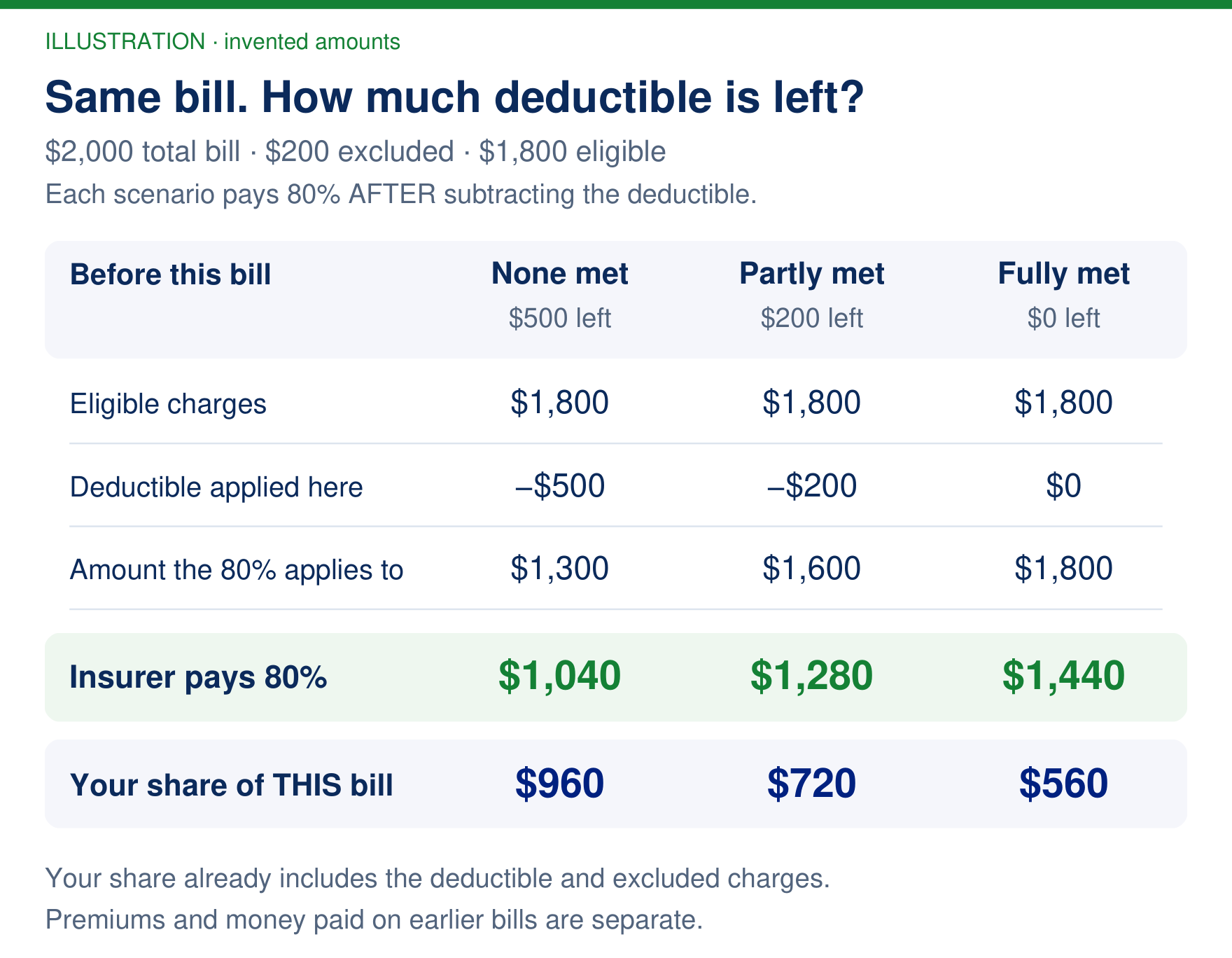
Figure text and data
Invented $2,000 vet bill: $200 excluded and $1,800 eligible. All scenarios apply 80% after the remaining deductible, with sufficient policy limit and no other reduction. With $500 deductible remaining, $1,300 remains for the percentage calculation; insurer pays $1,040 and you pay $960. With $200 deductible remaining, $1,600 remains; insurer pays $1,280 and you pay $720. With no deductible remaining, insurer pays $1,440 and you pay $560. Your share includes excluded charges, remaining deductible and the 20% share. Premiums and earlier bills are separate.
PetHSA Life illustration: invented amounts. These are shares of this bill only; earlier bills and premiums remain separate household expenses.
In the first case, the insurer pays $1,040 and $960 of this bill remains yours. That $960 already includes the $200 excluded charge, the $500 deductible and your $260 share of the remaining eligible cost. Do not add the deductible again.
If the deductible is partly met, the example payment rises to $1,280. If it was fully met before this visit, the payment is $1,440. You still pay the excluded charge and your percentage share. Meeting the deductible does not make every subsequent bill free.
The calculation order can change the answer
The first illustration subtracts the deductible before applying 80%. Embrace’s published V6 policy, Part VI, section 22, uses that order. The Pets Best / Independence American Alabama sample, section 8, applies the percentage first, then subtracts the remaining deductible. Here is what those two methods do to our invented bill when the full $500 deductible remains:
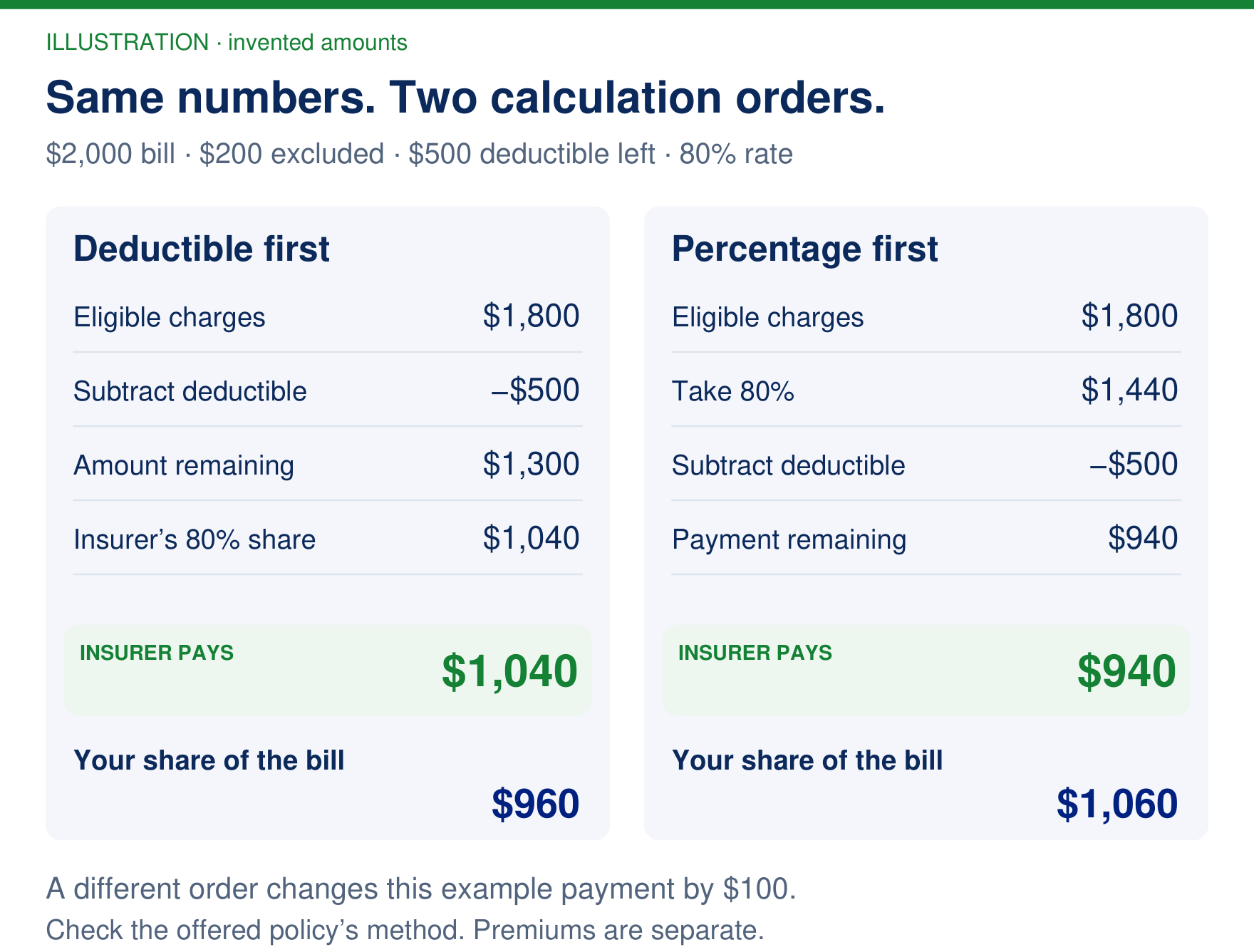
Figure text and data
Two invented calculations for the same $2,000 bill, $200 excluded, $1,800 eligible, 80% rate and $500 deductible remaining. Deductible first: $1,800 minus $500 is $1,300; 80% is $1,040 to the insurer and $960 to you. Percentage first: 80% of $1,800 is $1,440; minus $500 is $940 to the insurer and $1,060 to you. Only the calculation order changes. Premiums are separate.
PetHSA Life illustration: the same invented bill and coverage assumptions, with only the calculation order changed. These examples do not rank the policies as a whole.
You do not need to memorize either formula. Ask the insurer to show what its offered policy would pay on the same sample bill. The two numbers you need are the insurer’s payment and the share left to you.
Some policies instead use a schedule of allowances or another reimbursement basis. California’s checklist specifically flags this possibility. In that case, ask for a worked claim using the schedule; the advertised percentage alone will not tell you what remains unpaid.
The deductible’s reset matters over several visits
A deductible can start over each policy year, or it can be tied to a condition. Knowing when it starts over helps you understand a string of visits, rather than just the first bill.
An annual deductible applies within the policy’s defined year and resets for the next one. A per-condition deductible attaches to a condition; separate conditions may require separate deductibles. Trupanion, for example, describes its deductible as lifetime per condition, so it is not charged again for that condition after it has been met under the continuing coverage.
Neither structure is automatically better for every pet. One continuing eligible condition over several years and several unrelated eligible conditions in one year can produce different comparisons. The premium, deductible amount, exclusions and other benefits still matter.
For an annual deductible, check the reset date rather than assuming January 1. In the Alabama sample policy linked above, annual deductibles and limits follow the policy anniversary.
Also ask how the contract groups related conditions. A consumer’s idea of “two separate problems” may not be the policy’s definition. Get the insurer’s explanation before relying on a particular calculation.
Limits affect the next claim as well as this one
A policy may have an annual, per-incident or lifetime limit, or no limit of a specified type. Find out which applies and what uses it up.
An annual limit is shared across that policy year’s claims. Ask how much remains after a claim and when it resets. A new illness does not necessarily create a fresh allowance.
The calendar matters here, too. A course of treatment can extend across a renewal date. Ask what happens to deductibles, limits and continuing care at that boundary. It is a way to understand financial responsibility, not a reason to delay medically needed care to fit an insurance year.
Pre-existing conditions are about the history, not just the diagnosis date
An owner may reasonably think, “We did not know what it was until after I bought the policy.” The contract may still consider earlier signs or treatment.
Pets are family, but pet insurance is generally classified as property-and-casualty insurance. Human health-plan rules do not automatically apply. For example, Marketplace health plans must cover pre-existing conditions; a pet policy may exclude them.
Washington provides a useful pet-specific example. Its Pet Insurance law looks at prior veterinary advice, treatment, or verifiable signs and symptoms related to the claimed condition before coverage or during a waiting period. The important date may therefore be earlier than the day a diagnosis received a name.
Ask the insurer how it will assess your pet’s actual history and whether any exclusion can be reviewed under the offered contract. Do not assume that every past symptom creates a permanent exclusion, or that the absence of a diagnosis guarantees coverage.
Waiting-period protections also depend on the state and type of coverage. Under Washington’s pet-insurance statute, accident waiting periods are prohibited, and waiting periods cannot be reapplied when existing coverage renews. These are rules expressly written for pet insurance. Other states’ rules and the policy offered to you need their own check.
For your own policy, get the effective dates and waiting periods in writing. If something happens during a waiting period, ask how it affects later eligibility as well as the immediate bill.
Renewal deserves attention before the first renewal notice
There are several different issues to separate: whether coverage continues, whether the price changes, whether benefits change and how a condition already covered is treated.
Renewing the same coverage is different from buying a new policy elsewhere. Washington’s pet-insurance law says a condition covered under a policy cannot become pre-existing on renewal of that policy. That is protection for the continuing pet policy, not a promise that a new insurer must cover the same history.
That does not mean every policy everywhere has an unchanging price or an unconditional promise of renewal. Ask what the contract and your state’s rules say about rate changes, cancellation and nonrenewal, and whether claims, age or a move affect the price. California’s regulator includes renewal pricing among its recommended questions.
Nonrenewal is also more than a hypothetical concern. A September 2024 Kansas City Veterinary Medical Association report described Nationwide’s announcement that about 100,000 policies would not be renewed through summer 2025. According to the report, Nationwide said it was not choosing policies for nonrenewal based on a pet’s age, breed or claim history. It documents an announced action, not a completed count or the likelihood that any current policy will be dropped.
The practical response is to read renewal notices and understand continuity before changing coverage. A cheaper new quote may treat the pet’s existing history differently. Compare the new policy’s eligibility, exclusions and effective dates before canceling an old one; ask a licensed professional for help when the tradeoff is unclear.
Reimbursement and cash at checkout are different problems
Return to the first case in our $2,000 illustration: the insurer pays $1,040, leaving $960 of the vet bill to you. If the clinic requires payment in full before reimbursement, you still need access to the full $2,000 at checkout.
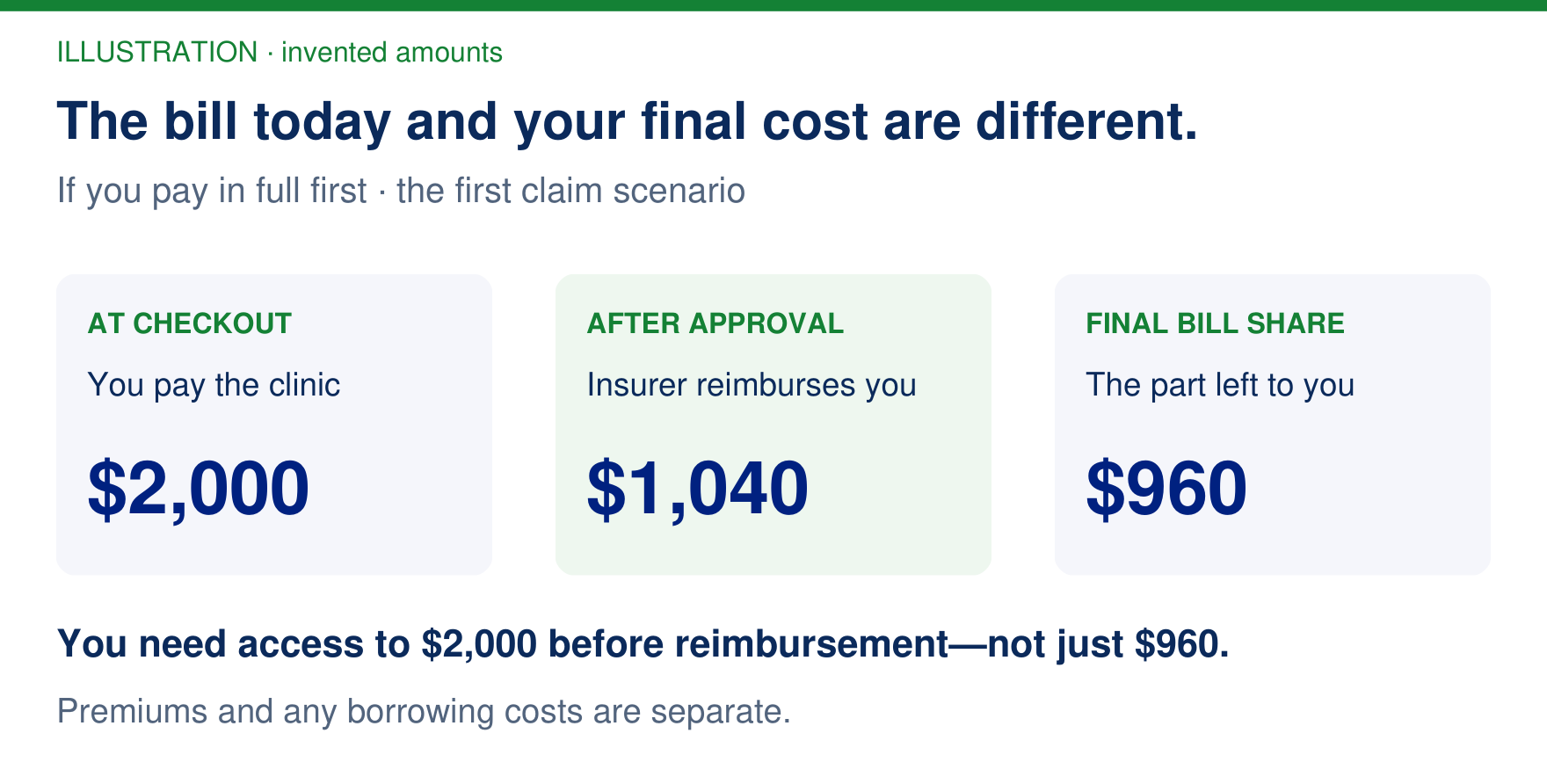
Figure text and data
Payment timing for the first invented claim scenario. If the clinic requires payment in full, $2,000 is paid at checkout. After approval, $1,040 is reimbursed. The final share of the vet bill is $960. You need access to $2,000 before reimbursement, not just $960. Premiums and any borrowing costs are separate; no reimbursement date is assumed.
PetHSA Life illustration: invented amounts from the first claim scenario. Premiums and any borrowing costs are separate.
That temporary gap can matter even when the claim is straightforward. Savings can cover it; available credit may bridge it, with its own repayment obligations and possible interest. A reimbursement you expect is not yet money you can spend.
How long could you wait?
Separate claim review from payment delivery. An insurer can approve a claim before a bank deposit or mailed check reaches you. Direct payment to a veterinary hospital is a different process again.
For example, Trupanion reports that more than 60% of its direct payments are made within 60 seconds. That refers to payments to participating hospitals. Confirm that your practice accepts the arrangement and how your claim would be handled; your own share still needs paying. Its hospital finder lets you check participating locations.
Embrace asks owners to allow 30 business days for accident-and-illness claim processing, while saying claims usually move faster. After completion, it says direct deposits generally take another two to three business days. It also says first claims and missing information can take longer. Those are separate stages, so a payment-delivery estimate is not the full waiting time.
Records can affect when review gets moving. Pets Best explains that claims needing medical records wait in a queue until those records arrive. Before choosing a policy, ask: “When does your processing clock start, what records will you need, and how long after approval should the money reach me?”
Keep a copy of the submitted claim, check for missing documents and ask what is still outstanding if it stalls. For your own cash plan, use a timeframe confirmed by the insurer and leave room for a delay. The goal is to avoid having a payment due before the reimbursement is available.
When comparing the year’s total, include the premiums plus your final share of the bills, along with any borrowing costs. The deductible is already part of that unpaid share. Counting it again would make the same care look more expensive than it was.
“Wellness plan” can mean two different arrangements
You can buy a standalone routine-care package from a veterinary provider without buying pet insurance. An insurer may instead sell wellness benefits as an optional addition to an insurance policy. Ask which arrangement you are considering; “wellness” does not mean they have the same purchase requirements.
Pets Best’s routine-care benefits, for example, are add-ons to insurance. They reimburse specified amounts for listed services, with prices and benefits varying by state and pet age. A headline “total benefits” figure is not necessarily a freely spendable allowance for any service you choose.
A standalone practice package instead provides a defined set of services for a contractual price. Banfield’s Optimum Wellness Plans are annual preventive-care packages, not insurance, with monthly or annual payment options. Early cancellation may leave an amount due based on services already used and payments made. Renewal settings also differ between payment arrangements.
The monthly charge, then, does not necessarily mean you can stop paying next month without another obligation.
Read the service list, benefit ceilings, eligible locations, contract term, renewal and cancellation provisions. If the pet moves, changes practices or dies, ask what the agreement says rather than assuming the payments automatically end.
Compare wellness value with care you expect to use
A package can be useful for predictable services and manageable payments. Its value to you depends on the appropriate care you expect to obtain, the actual benefit available and the total commitment.
Illustration — invented package. A plan costs $30 a month for 12 months: $360 for the year. The graphic compares two different sets of appropriate care you and your veterinarian expect to use. Bought separately, one would cost $310 and the other $420. In each case, assume the package fully includes those services with no additional fee.
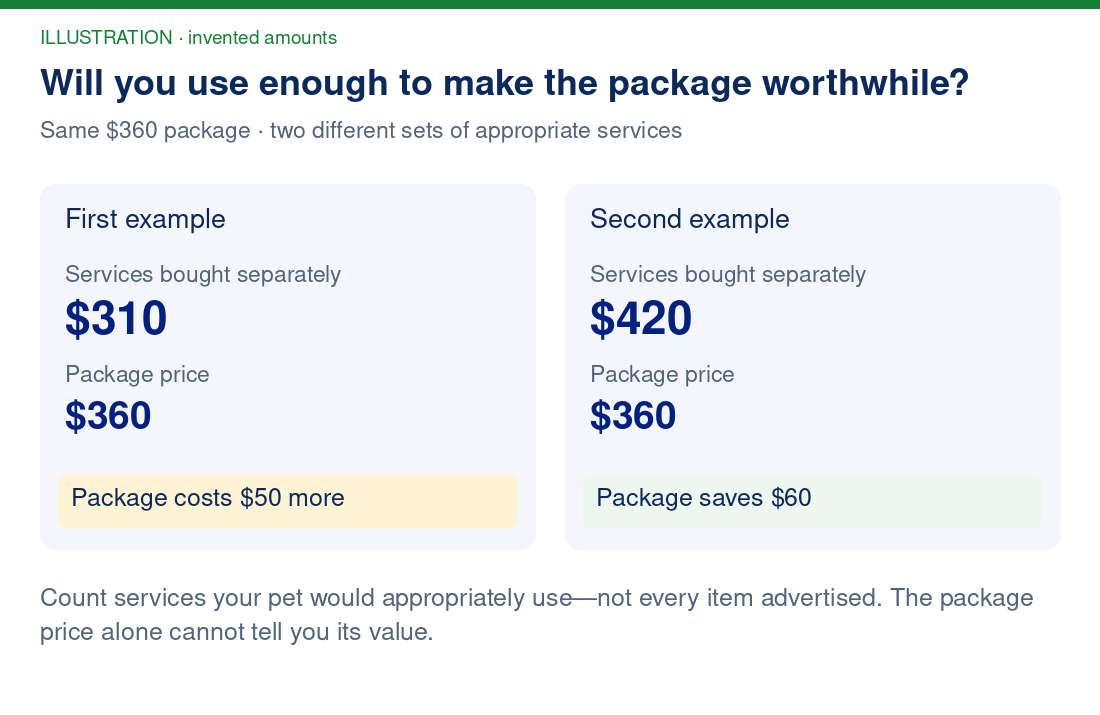
Figure text and data
Invented examples for a $360 wellness package. First: appropriate services would cost $310 separately, so the package costs $50 more. Second: appropriate services would cost $420 separately, so the package saves $60.
PetHSA Life illustration: invented amounts and stated assumptions, not quoted prices.
The answer changes with the care you would actually use. A package that makes recommended care easier to schedule and pay for may be worth a modest extra cost to you. In the first example, that means deciding whether the convenience and help keeping up with care are worth another $50 over the year. Extra services your pet does not need are not a reason to add care just to use the benefits.
For reimbursement benefits, compare the amounts the plan would actually pay for your expected services, not the retail value of every advertised item. For a service package, confirm what “included” means and whether associated items cost extra. Check its payment rules separately from the accident-and-illness policy; do not assume the same deductible or percentage applies to both.
Start with the care your veterinarian recommends, then choose an arrangement you can comfortably afford and use. A package can have value without being the cheapest option; it still needs to fit your pet and your household.
Avoid double counting in the household plan. If a package payment already funds a listed service, do not also reserve its entire standalone price as though no benefit exists. Keep any expected amount beyond the package visible.
Savings fill different gaps, and remain yours
Savings can pay for an excluded service, a deductible, a deposit, routine care or another need you choose. There is no claim-eligibility decision about using your own available money. The limit is the balance and any other commitments you have assigned to it.
That flexibility is valuable. So is recognizing how long the balance takes to build and what happens after it is used. A second bill may arrive before the reserve is replenished.
Flexibility also asks something of you. Unlike a premium, a savings contribution has no payment deadline imposed by an insurer. You may put off a transfer or use the fund for an unrelated purchase, planning to replace it later. If that replacement never happens, the amount in your plan can drift away from the money actually available.
A clear routine can take some of that decision-making off your plate. Give the money a purpose, decide what it can be used for, and check the balance on payday. A separately labeled savings pot or an affordable automatic bank transfer may help. The Consumer Financial Protection Bureau’s guide discusses these habits, keeping emergency funds accessible and avoiding overdrafts when saving automatically.
Not every missed contribution is a discipline problem. Rent, a repair or a smaller paycheck can leave no money to spare. If you pause or withdraw, record the new balance and a realistic date to review or restart. The aim is to keep one difficult month from becoming an abandoned plan.
A practical comparison can therefore include more than one arrangement: insurance plus savings for your share, savings without insurance, or either approach with a routine-care package that proves useful on its own terms. Keep premiums and package payments in recurring expenses; keep unspent reserves distinguishable from money already paid away.
Choose around the gap you most need to address
Ask yourself which problem is most pressing: a large eligible bill arriving early, a known annual expense that is difficult to pay all at once, care the proposed policy excludes, or cash needed while a claim is processed.
Then compare actual documents against that problem. Use the same pet details and coverage assumptions when seeking quotes. Ask for a sample claim, the relevant exclusions and renewal terms, and the full annual commitment for any service package.
Keep the regulator’s question checklist beside the quotes. You can also use a commercial comparison service to gather options, while checking which insurers it includes and how it is paid; a comparison page is not a substitute for the offered policy. A new diagnosis, renewal or move is a reason to look again before changing anything.
You can make this choice in stages. Understand the routine care, look at the protection available, and decide what money needs to remain accessible. The result should make you feel clearer about the help you have—not pressured to buy one more thing.
Examples illustrate particular contracts and jurisdictions, not nationwide terms. Insurers’ published timing statements describe different processes and are not guaranteed payment dates. Check the exact offered policy, service agreement and renewal notices before making a change.
By PetHSA Editorial Team
Sources
- NAIC — Pet insurance. Updated April 16, 2025; policy and payment variation.
- California Department of Insurance — Questions to consider when purchasing pet insurance. Reimbursement basis, limits and renewal questions; undated live guidance.
- Pets Best / Independence American Insurance Company — Alabama accident-and-illness sample policy, IAIC-PB10001-ILL. Sections 8 and 12; current linked sample reviewed, no issue date verified.
- Trupanion — How pet insurance deductibles work. Provider description of lifetime per-condition deductible; state terms control.
- Washington Legislature — RCW 48.205.020. Pre-existing-condition and renewal definitions; current codified text, enacted 2023.
- Washington Legislature — RCW 48.205.050. Waiting periods and renewal examinations; current codified text, enacted 2023.
- Samantha Bartlett, DVM / KCVMA — Nationwide Insurance to Non-Renew 100,000 Pet Insurance Policies. September 1, 2024; historical report of an announcement.
- Trupanion — How we work with veterinarians. VetDirect Pay and participation requirements; undated live page.
- Pets Best — Routine care coverage. Annual category limits and state/age variation; undated live page.
- Banfield — Optimum Wellness Plans. FAQ on annual commitments, cancellation and renewal; undated live page.
- CFPB — An essential guide to building an emergency fund. Updated October 29, 2025; household guidance.
- HealthCare.gov — Coverage for pre-existing conditions. Human Marketplace health-plan rules; undated live guidance, checked November 13, 2026.
- Embrace / American Modern — Pet Health Insurance V6. Insuring agreement and Part VI, section 22; deductible-first reimbursement. Public sample wording; state terms control; no issue date verified.
- Embrace — Pet Insurance Claims. Claim processing, first claims, missing information and payment delivery; undated live guidance, checked November 13, 2026.
- Trupanion — The New Pet Insurance Claims Experience. Company-reported direct-payment timing; underlying measurement period not stated on the page, checked November 13, 2026.
- Pets Best — What Happens After You Submit a Claim?. Medical-record requests and the processing queue; undated live guidance, checked November 13, 2026.