

Educational planning guide for U.S. pet owners. Dollar examples are invented. Use your actual bills, available savings and care advice when making a plan.
There is a small pleasure in paying a bill with money you set aside for exactly that purpose. The appointment still costs money, but it no longer has to undo the rest of the month.
That is a useful aim for pet savings. You do not need to forecast every illness or build a perfect fund before you begin. Start with the next bill you know about, then add a cushion at a pace the household can sustain.
Your monthly savings target is the money you need to set aside for future pet bills, plus what you choose to build for the unexpected. What you already have and when the bills are due matter more than a universal target.
We will work through one simple example. You can use it in a notebook, a spreadsheet, a bank’s savings pots or a planning tool—whichever makes the habit easiest to keep.
Jump to: Known bills · Emergency savings · When the target does not fit · Payday routine
Give the money a job
If you have already started saving, that counts. The next step is knowing what the balance needs to cover.
Imagine $500 set aside for your pet: $300 is for an upcoming appointment and $200 for a sitter. Both bills have a place. There simply is not another $500 available for an unexpected expense.
You can keep one account and a short list of what the money is for. Separate accounts are optional. Three plain labels may be enough:
- This month: purchases you are paying for now, such as food and litter.
- Coming up: money kept for bills already on the horizon.
- A cushion: money not yet promised to a particular bill.
The Consumer Financial Protection Bureau’s emergency-fund guide offers a useful starting point for the cushion. It emphasizes your circumstances rather than a single amount everyone must reach.
Start with one bill and its date
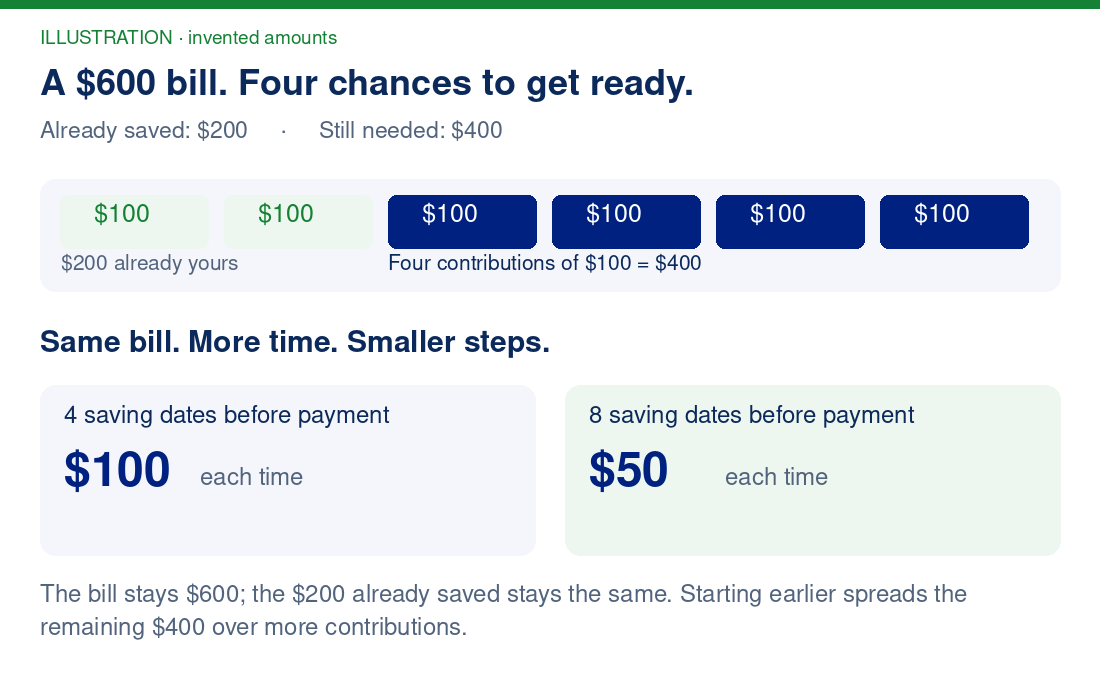
Let’s say a planned bill is $600, you have $200 saved for it, and there are four monthly saving dates before payment. These are made-up figures to show the method.
Read the figures as text
Invented illustration: $600 bill minus $200 already saved leaves $400. Four contributions of $100 reach $600. If there were eight saving dates before the same bill, eight contributions of $50 would cover the same $400 gap. No interest or withdrawals assumed.
Illustration: invented amounts and stated assumptions, not quoted prices.
That is the whole calculation: the amount still needed, spread across the chances you have to add money before it is due. In this example, $600 minus $200 leaves $400; four contributions of $100 cover it. If you had started with eight saving dates available instead, the same gap would take $50 each time. More time changes the size of the step, not the price of the care.
For a real bill, put the payment date beside your paydays. The consumer bureau’s free bill calendar gives you a ready-made page to use. It is a household worksheet, so you can see the pet bill alongside rent and the rest of life.
If the required contribution is uncomfortable, finding that out early is useful. You can discuss medically appropriate timing with the clinic or adjust a flexible booking while choices remain. The calendar is there to help you, not to deliver a verdict.
See what leaves your paycheck—and what stays yours
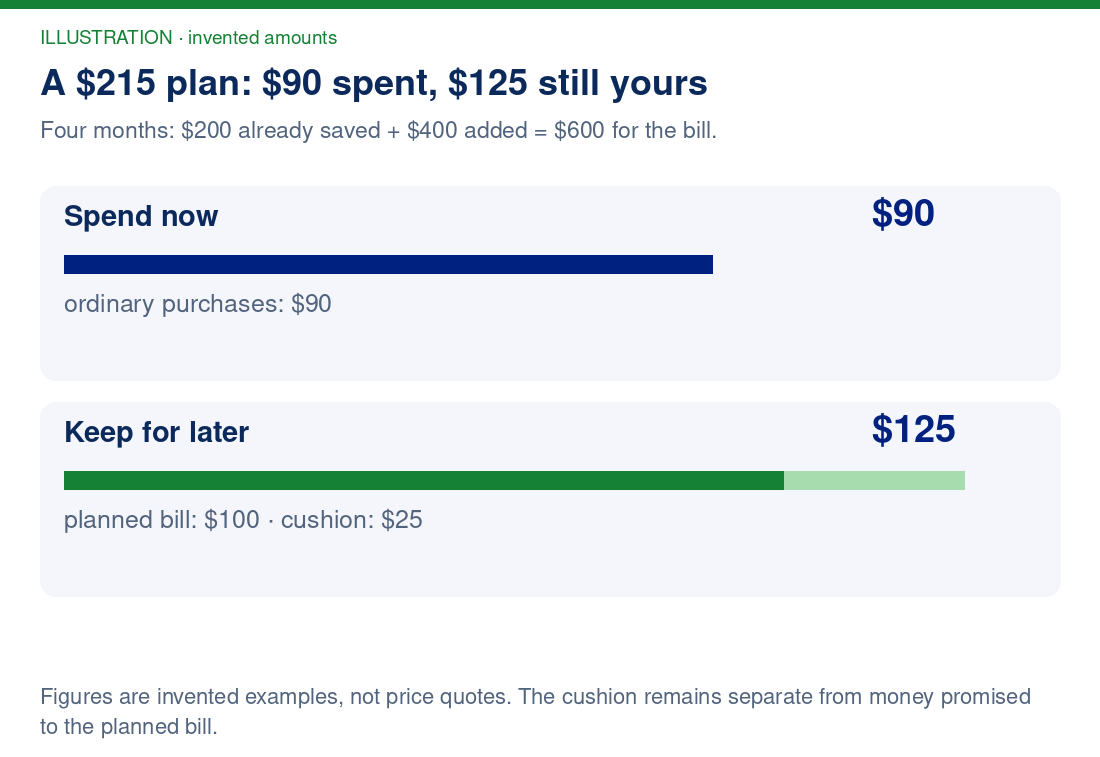
Now put that $100 beside ordinary spending and a small extra cushion. This continues the same made-up example.
Read the figures as text
A $215 plan does not mean $215 has been spent. ILLUSTRATION • one month of purchases and saving. Spend now: ordinary purchases $90; total $90; Keep for later: planned bill $100, cushion $25; total $125. $90 spent + $125 saved = $215 in the monthly plan.
Illustration: invented amounts and stated assumptions, not quoted prices.
Of the $215, $125 is saved and $90 is spent. After four contributions, the planned bill has its $600 ready: the original $200 plus four lots of $100. Paying it from that money is the plan doing its job.
The cushion would have grown by $100 if nothing had been withdrawn. Small contributions can become useful balances; they do not need to look impressive on day one.
When the next saving cycle starts, check the date again. A full year to prepare for the same bill gives you more breathing room than four months. You can choose what to do with that difference.
An emergency fund is a balance; saving is how you build it
“I save $50 a month” describes a habit. It does not tell you what bill you can pay today.
A new fund takes time to grow. An expense arriving early can exceed the balance, even when you have kept every contribution you intended to make.
That is why a reserve target and a monthly contribution answer different questions:
The target asks: How much money do I want available?
The contribution asks: How quickly can I build or restore it?
Choose a first milestone you can picture: a deposit, your share of a possible insured bill, or another amount meaningful to your household. Ask your practice how payment works, and use your actual policy terms if you have insurance. The aim is a useful first cushion, with room to grow.
The purpose is to make the next step concrete. “Build some protection” is hard to act on. “Keep this money unassigned, and add this much on each payday” is something you can do.
You might leave the cushion untouched for a long time or need it more than once in a short period. After using it, look at what remains and decide on the next achievable step. Rebuilding is part of the habit.
Last year’s bills are useful, but they are not the whole forecast
Your actual purchases are often a better starting point than a stranger’s average. They reveal the food you buy, the grooming interval you use and the services available near you. The Consumer Financial Protection Bureau recommends reviewing several months of statements and including expenses that occur less frequently when assessing spending.
Then ask what made those months unusual.
A first year may include equipment you will not buy again next year. A quiet year may contain no boarding because you did not travel. A new medication may have started only recently, so last year’s total understates its next full year of cost. A postponed appointment is an unpaid need, not necessarily a saving.
Give each substantial line a basis: a recent receipt, a written quote, a renewal notice or a provisional allowance. Include the date. This makes a review much easier: you can replace one old assumption without rebuilding the whole plan.
For a bill with a quoted range, consider what the lower and higher amounts would require. A range is most helpful when it changes a decision. If only the lower end fits, the next step is to understand what would move the bill upward and discuss the gap before the appointment.
What if the calculated amount does not fit?
This is where a plan becomes useful—and where it needs to be humane.
If the target exceeds what remains after housing, food and other essential commitments, the arithmetic has revealed a constraint. It has not measured how much you care about your pet.
Start with the mismatch you can identify. Is the problem a predictable bill coming too soon, a recurring expense that has increased, or a reserve goal that is too ambitious for the current year? Those call for different conversations.
For planned medical care, tell the veterinary team what you can pay and when. Ask what needs attention now, what options are medically reasonable, and what the consequences of waiting would be. The American Animal Hospital Association’s community-care guidance supports discussing acceptable care options in the context of a family’s resources; it does not imply that every cheaper option has the same outcome.
For nonmedical commitments, you may be able to change dates, arrange different care or remove an optional purchase. Check existing cancellation terms before assuming a booking can be changed without cost.
If assistance may be needed, ask the practice about local resources and check each program’s eligibility and timing. RedRover’s assistance directory provides links to state, national and condition-specific programs, plus help with routine needs. A crowdfunding campaign invites contributions rather than guaranteeing them. The Federal Trade Commission’s crowdfunding guide explains why fees, who receives the money and when it becomes available deserve a look. Keep requested help separate from money confirmed and available.
A smaller sustainable contribution can still build something useful. Keep the unfunded amount visible rather than lowering the estimated cost merely to make the spreadsheet balance.
Choose a rhythm that fits your paydays
Monthly is a convenient way to talk about costs. It does not have to be the way you save.
If income arrives every two weeks, a contribution on payday may be easier to remember. If earnings vary, a small regular amount plus additions in stronger months may fit better. Check the actual dates so a contribution will arrive before the bill it is meant to cover.
Automatic bank transfers can help if they suit your cash flow. Keep the amount comfortable enough to avoid making another essential bill late, and check balances when income or expenses change. The consumer bureau’s savings guidance includes this reminder.
Make the routine small enough to repeat. You might check the next few bills after payday, move a comfortable amount into savings, and label what it is for: the next examination, a replacement carrier, travel care or a cushion. Watching an amount grow toward a specific purpose can give you a small win to notice along the way.
Researchers have tested whether reminders help people follow through on saving. In a randomized study of nearly two million U.S. bank customers, published in 2025 using a two-month experiment in 2022, weekly reminders and congratulations for recent savings produced a small increase in one-time savings transfers. A reminder can help with follow-through; it cannot create spare income.
For your pet’s plan, put a reminder on the calendar for payday or set up a bank transfer you can comfortably afford. Then check whether the routine helps. The consumer bureau’s savings guidance recommends a specific goal, consistent contributions and checking your progress. If income varies, make the routine a balance check first and a contribution when the money is available. Keeping the habit of checking still counts.
Protecting the balance is part of the routine, too. An unrelated purchase can be tempting when the money is easy to reach, especially if you tell yourself you will replace it. Decide what the fund is for before that choice comes up. A separate, clearly labeled savings pot may help you notice the tradeoff; it does not make the money untouchable. If you use it elsewhere, update the balance and set a realistic date to rebuild.
Insurance changes what you save for, not whether cash matters
If you have pet insurance, include the premium—the price of the policy—in recurring spending. Separately consider the deductible, which is the amount you pay toward eligible care before the relevant benefit applies, along with other costs the policy leaves to you. Most policies reimburse the owner after a claim, although direct-payment arrangements also exist. Ask what cash you need at the appointment and whether your savings or available credit can cover it. If using credit, include its repayment cost; reimbursement may not arrive before a payment is due.
Do not subtract an expected claim payment from your bank balance before it arrives. You can record it as a possible future reimbursement, with its status clearly marked.
Likewise, a wellness package may already include a service on your list. Count the package payment and any remaining out-of-pocket amount, rather than counting the full service price a second time. Our insurance, wellness and savings comparison explains the contracts and tradeoffs before you add a payment to the plan.
A plan should get better as you live with it
Review the next few payment dates when you check the household bills. Make a more substantial update when something changes: a new diagnosis, a revised treatment estimate, an insurance renewal, a move, another pet, a different work schedule or an upcoming trip.
After a withdrawal, decide what needs rebuilding. A planned bill paid from its assigned money may simply start a new saving cycle. An unexpected withdrawal may leave a reserve that needs a new target date.
Sometimes a contribution is missed because life simply does not leave room for it: reduced hours, a household repair or another essential bill. That does not make the effort you have already made a failure. Looking ahead and trying to prepare is a useful step, even when a particular month’s contribution is zero.
Begin again with the balance actually there and the time remaining. If you pause a contribution, put a date on the next review so one missed payday does not become an indefinite stop. A missed month is information, not a reason to abandon the plan. If the new amount will not fit, talk about the gap while there is still time to respond.
After one or several difficult months, a specific request for help may also be worth considering. If you choose to ask family, friends or a crowdfunding community, explain the care or expense you are planning for, what you can contribute, what changed, and the amount still needed by the payment date. Count help toward the bill when it is available; keep working with the practice or provider on a realistic option if the request falls short.
Spreadsheets and planning tools can make these reviews easier. Research-enabled AI can also help organize costs and check arithmetic when the inputs and dates are explicit. The useful test is whether you can see what the plan assumes and update it when real life supplies better information.
For today, choose one next bill, write down its date and give the money already saved a clear job. That is a real improvement. You can add the next piece when you are ready—and enjoy the ordinary days with your pet in the meantime.
A monthly target does not guarantee enough cash for every bill. Review the money available and payment dates as well as the amount you intend to save.
By PetHSA Editorial Team
Sources
- CFPB — An essential guide to building an emergency fund. Updated October 29, 2025; household guidance.
- CFPB — Bill calendar. Undated worksheet; due dates and income timing.
- CFPB — Assess your spending. Updated December 12, 2024; general spending method in a home-buying guide.
- Greenberg and colleagues — 2024 AAHA Community Care Guidelines for Small Animal Practice. JAAHA 60:227–246; guideline, not a trial. Supporters: CareCredit, Hill’s, Merck Animal Health and Pawlicy Advisor.
- RedRover — Urgent care information and resources. Resource directory; check each program directly.
- NAIC — Pet insurance. Updated April 16, 2025; reimbursement and policy variation.
Milkman and colleagues — Can reminder emails compel Americans to save? A two-million-person megastudy. PNAS Nexus 4(9), 2025; March–April 2022 experiment at one U.S. bank. Bank-supported research; modest transfer effects, no significant primary balance effect. August 18, 2026 correction changes the author list.
FTC — Donating Through Crowdfunding and Fundraising Platforms. September 2025 guidance on fees, recipients and payout timing; not evidence that a particular fundraising story raises more.