

Educational guide for U.S. dog and cat owners; amounts are U.S. dollars. Examples labeled as illustrations use invented amounts. For individual care, coverage or borrowing decisions, consult the relevant professional and actual terms.
The adoption fee tells you what it costs to bring a pet home. The first few weeks begin to show you what it will cost to live together.
There are meals and veterinary visits, of course. There is also the coat that needs care, the workday that needs covering, the cleaning supplies you keep replacing and the trip that means finding someone you trust. A pet’s cost is partly the animal, partly your circumstances, and partly the choices you make along the way.
Some owners recognize their own spending in published estimates. Others will have spent more in the first few months and wonder whose pet the study is describing. Both reactions make sense: a published estimate is an introduction, not a description of your household.
Understanding the differences gives you choices. You can put money toward the care that matters, find suitable options you can sustain, and leave some of the tempting extras on the shelf. You do not need to buy the most expensive version of pet ownership to build a good life with an animal.
This guide follows the costs from bringing a pet home through everyday life and the less predictable years ahead. The aim is to help you feel informed enough to make the next decision—not to turn you into a forecaster.
Jump to: Annual costs · Bringing a pet home · Workday care · Veterinary bills · Insurance · Unexpected bills
What does a dog or cat cost per year?
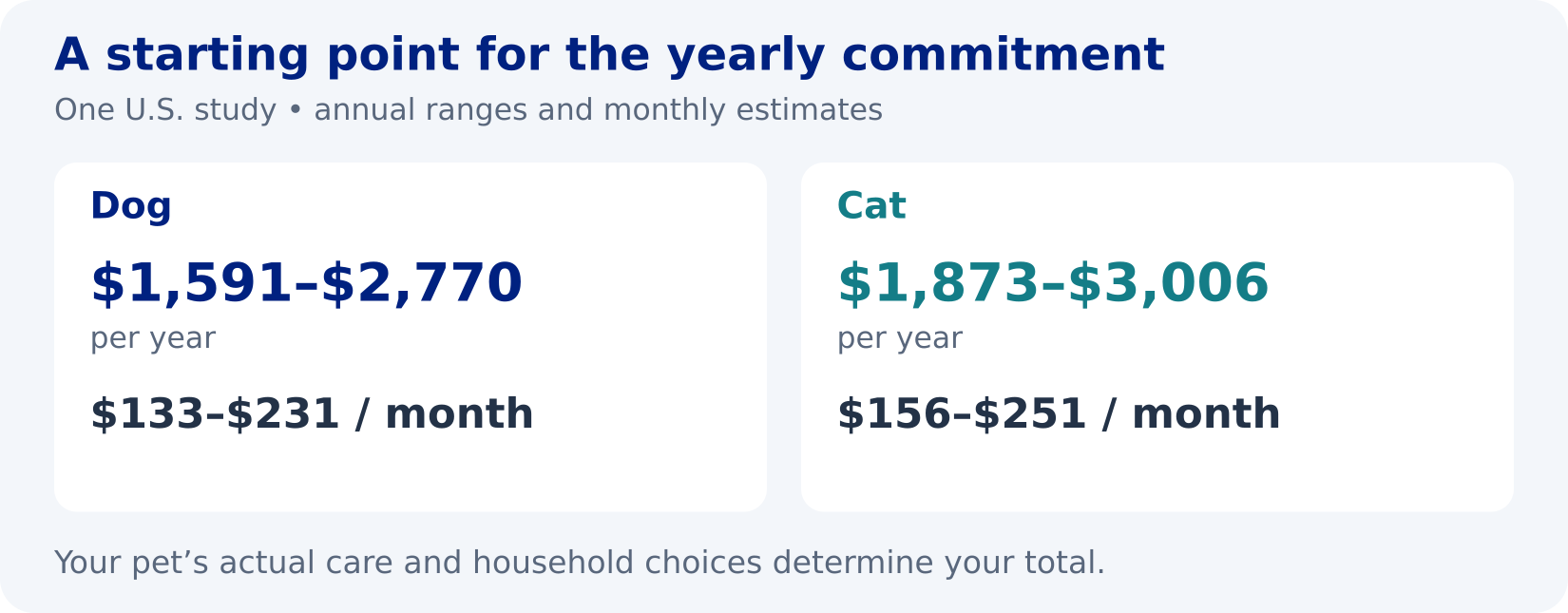
The 2025 Pet Lifetime of Care study offers one U.S. estimate of the annual commitment. Dividing those figures by 12 gives a sense of the monthly scale:
View the figures as a table
| Pet | Annual estimate | Monthly equivalent |
|---|---|---|
| Dog | $1,591–$2,770 | About $133–$231 |
| Cat | $1,873–$3,006 | About $156–$251 |
Source: Synchrony’s 2025 Pet Lifetime of Care study, dog and cat cost summaries. Monthly equivalents are rounded; they do not describe when bills arrive.
Think of these figures as an introduction to the scale of the commitment. They combine different care and purchase choices; your own total depends on which ones apply. The cat range being higher in this study does not mean a cat is necessarily the more expensive choice for your household.
Two families can each own one healthy adult dog and have very different bills. One provides all daily care at home; the other pays for help during the workweek. Add a therapeutic diet or regular medical monitoring, and the comparison changes again. An annual total can hide those differences unless you can see what went into it.
Published figures can also answer different questions: one pet or the whole household, veterinary care alone or all ownership expenses, the first year or an ordinary adult year. Spending surveys have another complication: they record what people paid, which can leave out care a family could not afford or reach. Read the description behind a number before comparing it with your own bills.
The way to make those numbers useful is to follow the pet home: what comes with the adoption, what needs buying again next week, and what might change over the years.
The first bill: bringing a pet home
An adoption fee may include medical services you would otherwise buy separately. Before comparing two fees—or a fee with a “free” animal—find out what comes with each.
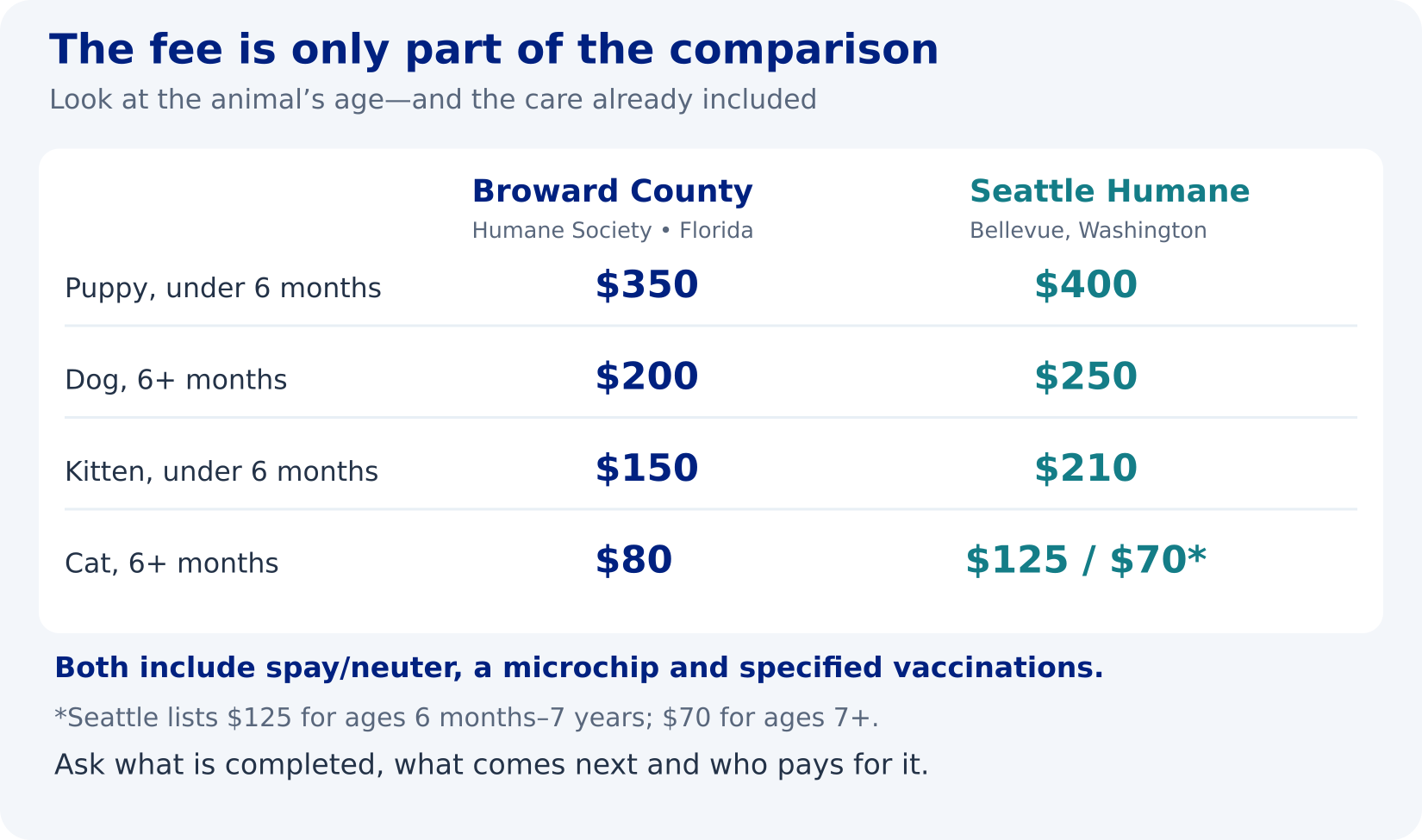
The Humane Society of Broward County in Florida and Seattle Humane in Bellevue, Washington, both include spay/neuter surgery, microchipping and specified vaccinations in their adoption arrangements. Their posted fees also vary with the animal’s age:
View the figures as a table
| Animal | Humane Society of Broward County | Seattle Humane |
|---|---|---|
| Puppy, under 6 months | $350 | $400 |
| Dog, 6+ months | $200 | $250 |
| Kitten, under 6 months | $150 | $210 |
| Cat, 6+ months | $80 | $125 / $70* |
*Seattle Humane: $125 for cats 6 months to 7 years; $70 for cats 7 years and older. Both providers include specified initial medical care.
Sources: Humane Society of Broward County and Seattle Humane; fees checked November 12, 2026. These are two providers’ prices, not a national range.
That changes the meaning of a “free” kitten. If you still need to pay for services included in another kitten’s adoption fee, the apparent savings may shrink or disappear. An adopted animal can need further care too. The helpful question is what has already been done: ask for the medical record, the next care due and who is responsible for it.
If you are buying from a breeder, separate the purchase price from the cost of care. Ask what veterinary examinations, breed-specific health testing, vaccinations, and contractual commitments are included. A higher purchase price does not guarantee a healthier dog—or lower veterinary bills in the years ahead.
It's a common assumption that buying a purebred dog from a breeder means getting a healthier animal. But the evidence tells a more complicated story. In a University of California, Davis study of 24 inherited disorders, 10 were more common in purebred dogs, 13 occurred at similar rates in purebred and mixed-breed dogs, and just one was more common in mixed breeds. A separate 2021 study examining genetics and Swedish pet insurance records found 29% more recorded episodes of non-routine veterinary care in the breed group with the least genetic diversity than in mixed-breed dogs. The study measured veterinary care, not treatment costs, and neither finding means every mixed-breed dog will be healthier than every purebred. But together, they challenge the idea that a breeder's price tag buys greater peace of mind.
A mixed-breed rescue can be a wonderful—and potentially much more affordable—alternative to purchasing a purebred dog. Adoption fees are often substantially lower than breeder prices, and some shelters and rescue organizations include initial vaccinations, spaying or neutering, and other veterinary care. Of course, adoption is not a guarantee of good health or lower lifetime expenses, either. Purebred dogs can be adopted, and mixed-breed dogs can develop serious medical conditions all the same. Whatever dog you choose, review its available health records, understand its individual needs, and plan for future care.
Then comes the setup: a suitable carrier or restraint, bowls, a place to rest, identification and the supplies needed to keep the animal and home clean. Dogs may need a leash, harness, waste bags, gates or an appropriately used crate; cats need litter facilities, scratching surfaces and places to retreat and explore. Some items need replacing as an animal grows. Others are durable purchases, not monthly expenses.
Check local licensing or registration fees and renewal dates, too. New York City’s dog-licensing rules, for example, allow licenses lasting from one to five years. Your own city or county can tell you what applies to your pet.
It is easy for the shopping list to grow faster than the animal’s needs. A basic litter box and an automated one perform related jobs at very different prices. You may value the convenience of the upgrade; you can also choose the simpler version. A premium shopping list is not the entry requirement for giving a pet a good home.
The first year can also include a series of visits and preventive treatments, training and a spay/neuter procedure if it has not already been performed. Your veterinarian can identify what is appropriate and when. Counting an already completed procedure again, or assuming every service is included in an adoption, can distort the total in opposite directions.
The costs that follow you home
Food: the foundation deserves more attention than the extras
Food is a good place to make a thoughtful choice early. The question is which diet and feeding amount suit the animal, not which bag looks most impressive. Veterinary nutrition guidelines emphasize an appropriate diet, body condition and reassessment as needs change.
The label’s “complete and balanced” statement helps identify a food intended to supply the required nutrients for a stated life stage. A treat or supplement usually has a different purpose.
An affordable suitable food can be a sound choice. The World Small Animal Veterinary Association’s food-selection guide helps you look beyond marketing terms to the maker’s nutrition expertise and quality controls.
Before adding vitamins, joint products or toppers, ask what benefit each is intended to provide and whether your pet needs it. Nutrition is a foundation; extras should have a reason. If a diet or supplement is part of treatment, discuss affordable appropriate options with the veterinarian before changing it.
Then compare what feeding the animal actually costs. A cheaper bag may run out sooner.
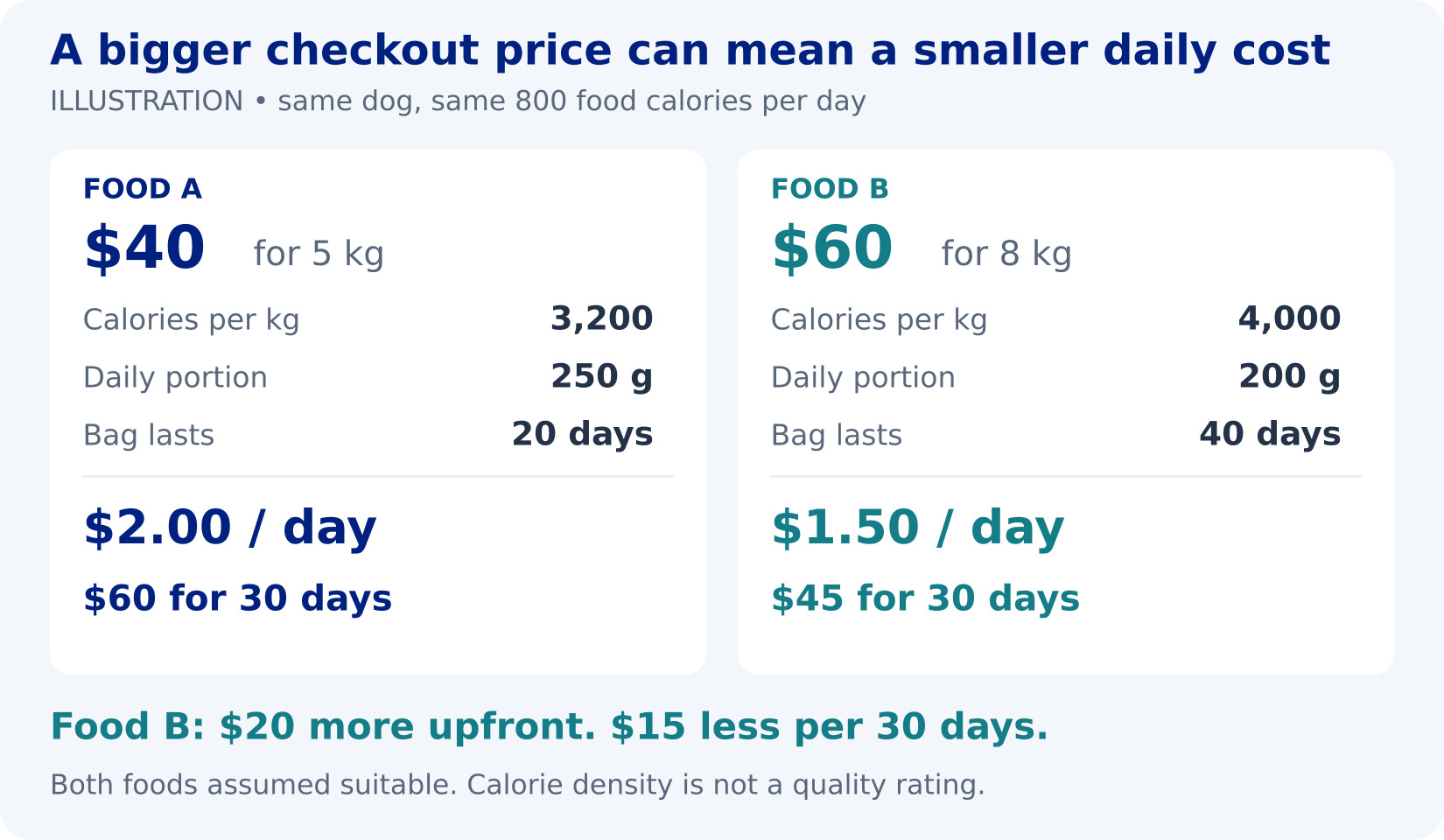
Illustration: the same dog, two suitable foods, two very different refill schedules. Suppose a veterinarian has established that this hypothetical dog needs 800 food calories a day. Both foods are assumed to meet its nutritional needs. The prices, bag sizes and calorie contents below are invented; 800 calories is not a feeding recommendation for your pet.
View the figures as a table
| Assumption or result | Food A | Food B |
|---|---|---|
| Price at checkout | $40 | $60 |
| Bag size | 5 kg | 8 kg |
| Food calories per kg | 3,200 | 4,000 |
| Daily portion for this dog | 250 g | 200 g |
| How long the bag lasts | 20 days | 40 days |
| Cost per day | $2.00 | $1.50 |
| Cost per 30 days | $60 | $45 |
Invented example. Both foods are assumed suitable and supply the same 800 food calories per day.
Illustration: invented prices and feeding assumptions. Food calories may appear as “kcal” on the label. Compare suitable diets at the amount your pet needs; calorie density alone does not establish nutritional quality.
Food B costs $20 more at checkout but $15 less over 30 days—a 25% lower feeding cost in this example. Its larger bag and more concentrated calories both matter. The portion is smaller because it supplies the same energy, not because the dog is being fed less than it needs.
The larger purchase still requires more cash upfront, and a bag is only good value if you can store it properly and use it within the maker’s guidance. Ask the veterinary team to help establish a suitable feeding amount, then compare daily cost using the label and your actual refill dates. You do not have to judge a food by price alone—or work out a whole nutrition plan yourself.
Litter, coat care and the things you use up
Cats bring a recurring litter expense as well as the initial boxes. The cost depends on the product, how much you use, how often it needs changing and the number of animals using it. A bargain purchase that your cat will not use does not solve the problem.
A short-haired dog may never need a professional haircut. A dog with a coat needing regular trimming can bring an entirely different routine. Even similar-sized dogs may differ, and the ASPCA’s coat-care guide explains why brushing needs vary. Ask what you can comfortably manage at home and what help this particular animal needs. No salon appointment does not mean no coat or nail care; it means the work may happen differently.
That difference can continue beyond the groomer. Shedding may mean more cleaning and laundry at home. Your time and tolerance for that work matter, too. A cost checklist becomes useful when you adapt it to the life you can actually provide.
The same logic applies to nail care, cleaning supplies, replacement toys and damaged or outgrown equipment. A recurring need should not disappear simply because it is not veterinary care. An optional upgrade should not become a requirement simply because it is on a shopping list.
Routine veterinary care: more than an appointment fee
When you call a practice to ask the price of a visit, you may be quoted only the examination fee. Vaccinations, parasite prevention, tests, medications and procedures can be billed separately. A more useful conversation starts with your pet’s age, records, environment and health, then asks what care is likely to be due and what the itemized estimate includes.
An indoor cat still needs veterinary care. The 2021 feline life-stage guidelines recommend at least annual examinations for cats, with frequency adjusted to the individual. They also stress that age categories are a starting point for personalized care: a healthy older cat and another cat of the same age with ongoing disease may need different attention.
These visits also give you a chance to look ahead with someone who knows the animal. Ask what is due now and what is likely to come next. Preventive care should be chosen for its health value and suitability; a service can be worthwhile without a promise that it will save more money than it costs.
Dental care is a good example of why the name of a service can undersell what it involves. “Teeth cleaning” sounds straightforward, but a professional dental procedure includes more than removing visible tartar. The American Animal Hospital Association’s guidelines describe assessment under anesthesia, dental X-rays and treatment based on what is found. Looking into an awake animal’s mouth cannot reveal the full picture.
That helps explain why a cleaning estimate can change if extractions or other treatment prove necessary. Before a planned procedure, ask what is included, how additional findings will be communicated, and what you are authorizing. Two advertisements for “dental cleaning” may describe substantially different services.
Sometimes the biggest cost is your schedule
A change in the working day can add a substantial pet-care bill without any change in the animal’s health. Paid help may be the difference between a routine that works and one that leaves everyone stretched.
A February 2025 discussion in r/dogs captures the surprise. The original poster was adjusting to a household’s return from remote work and facing almost $600 a month for daycare. Other owners recognized the strain: one described roughly $500 a month for a dog they said struggled to be left alone; another reported $50 a day, three days a week, for similar reasons.
But a new work schedule does not produce the same bill in every home. In that same discussion, another owner reported no daycare or walker expenses because both partners worked hybrid schedules and one came home early in the afternoon. Their solution was available time, not a cheaper version of the same service.
These accounts make a useful question tangible: which parts of your working week need covering, and who can realistically cover them? A paid arrangement can be a significant commitment; family help or compatible schedules can change it. Neither tells us what every dog needs or what owners everywhere pay.
The best arrangement is the one that meets this pet’s needs and works for the people caring for it. A walker, family help or a different schedule may each play a part. If the animal struggles with time alone, seek advice rather than assuming a more expensive service will solve it. The Merck Veterinary Manual describes several influences on anxiety and the need for an individual assessment. A difficult outcome is not proof that an owner failed to buy the right service.
Travel can change the calculation too. Ask how boarding or sitting is charged, whether medication administration costs extra, and which health records the provider requires. An animal with ongoing treatment may need someone with different skills or availability from a sitter making a short visit.
Look beyond the pet aisle. Check a rental agreement for any applicable pet charges and distinguish a refundable deposit from a nonrefundable fee. Consider transport to appointments, time away from work and whether someone can provide care during recovery. A deposit ties up money even if it is eventually returned; a recurring fee is money spent.
Before choosing a pet, picture an ordinary Tuesday as well as the weekend you bring it home. Who is there, who can help, and which parts of the day will require paid care? Those answers can be more revealing than another national average.
What makes a veterinary bill expensive?
When your pet is unwell, you may want two answers at once: what is wrong, and what it will cost to help. The veterinary team may need to investigate the first before it can answer the second fully.
The examination fee buys an assessment. Tests, treatment and follow-up may come afterward. The same outward symptom can have different causes, so the next step—and the estimate—can change as the team learns more. Understanding that sequence makes it easier to ask what a quoted figure covers.
One useful real-world example comes from the University of Illinois Veterinary Teaching Hospital. Its orthopedic service posts rough surgery estimates ranging from $2,500 to more than $7,000, including the examination, diagnostic workup, surgery, anesthesia, immediate postoperative care and medications. Its FAQ also explains that follow-up sedation and X-rays may carry additional charges.
In that example, much of the immediate care is bundled into the surgical estimate, but the return visits still deserve a question. Recovery can also mean transport, help at home and changes to normal activity. Thinking in terms of the whole episode of care gives you a fuller picture than the name of the operation alone.
The price of treatment and the cash needed today are different
Payment arrangements deserve a question of their own. Cornell’s Companion Animal Hospital, for example, says outpatient services are paid in full at the time of care. For hospitalized patients, it expects a deposit of at least half the highest estimate at admission, with the remainder due at discharge.
A family may be able to absorb a cost over a year and still struggle to produce it on a particular afternoon. That distinction matters whether the eventual payer is the household, an insurer or a lender.
Nor do medical costs always arrive as one dramatic event. A continuing illness can create a succession of smaller bills for treatment, monitoring and reassessment. A pet can also have more than one unrelated problem. There is no rule that an “emergency allowance” buys one emergency or that a quiet year guarantees the next one will be quiet.
There are two different questions here: “What would this care cost?” and “Will my pet need it, and when?” A written estimate can help with the first. Nobody can promise the second. Planning is still useful because it brings the knowable pieces into focus and leaves room to consider help for the rest.
A useful treatment conversation includes the family
Discussing money while worrying about an animal can be uncomfortable. Bring financial limits into the conversation early, along with what you can manage at home. Ask what the veterinarian is trying to achieve, which steps are time-sensitive and what reasonable alternatives mean for comfort, likely outcome and cost.
AAHA’s community-care guidelines support offering a range of medically acceptable options that reflect the patient’s needs and the family’s circumstances. That does not mean all options have identical results, or that every case has an inexpensive solution. It means those circumstances belong in the conversation.
The ability to administer medication, make follow-up visits or manage recovery can matter alongside the amount on an estimate. Choosing care involves the animal’s welfare, the likely benefit and the family’s resources. A family’s spending is not a measure of how much it loves its pet.
Does where you live change the cost?
Location affects which providers are available as well as the prices they charge. Local labor and premises costs sit alongside equipment, supplies and staffing outside normal hours. The British Small Animal Veterinary Association’s explanation of practice costs identifies these inputs; Cornell describes the equipment, medicines and level of care behind its own hospital costs. Those explanations identify cost pressures, without telling us how much any particular U.S. clinic should charge.
A primary-care appointment, a subsidized vaccination clinic and a specialist hospital operating through the night also provide different services. Their prices are not interchangeable comparisons.
Access adds another dimension. A lower quoted fee may require a longer journey, time off work or travel to a referral center. Research on access to veterinary care treats affordability, availability and physical accessibility as distinct issues. A 2025 scoping review also found substantial differences in how studies measure access, limiting simple comparisons.
Your usable options matter more than an urban or rural label. A national city-versus-rural percentage cannot describe the services and travel involved for every household. Comparable local quotes make the picture more specific; knowing where your practice sends emergencies and specialist cases tells you which other providers may become part of it.
Size, breed and age matter—but not in one simple formula
Some differences are practical before they are medical. A larger animal may need more food and larger equipment. A particular coat may need more maintenance. A young animal may outgrow supplies or need substantial training and supervision. An adult animal with records can offer more information about existing needs, without making future health certain.
Medical research is more complicated than a ranking of “cheap” and “expensive” breeds. A Dog Aging Project study of 27,541 U.S. dogs found different disease-history patterns across body sizes: larger dogs had more reported history in some categories, while smaller dogs had more in others. The study used owners’ reports of past diagnoses, not a trial predicting the next bill for a newly adopted dog.
Breed can point to useful questions. A UK study using 2016 veterinary records found French Bulldogs had higher adjusted odds of several breathing and skin-fold disorders than other dogs, while also having lower odds of other disorders, including retained baby teeth—teeth that had not fallen out when expected. The French Bulldogs were much younger as a group. Researchers adjusted for age and other recorded differences because a raw comparison would mix those influences with breed.
Why does that matter? Without allowing for age, a study could mistake a difference between younger and older dogs for a difference caused by breed. The researchers tried to separate those influences. Their results help you ask informed questions; they cannot tell you which illness your own dog will develop or what a U.S. clinic will charge.
Different studies illuminate different parts of that picture. The Swedish insurance analysis discussed earlier counted nonroutine care across breed groups. A U.S. Dog Aging Project study, drawing on 27,541 dogs’ owner-reported histories, did not find a higher overall lifetime prevalence of reported medical conditions in purebreds. Neither measured what an individual U.S. family would spend. The sensible conclusion is to investigate the specific breed and animal, rather than treating “purebred” or “mixed-breed” as a complete health forecast.
Use that information to have a more specific conversation before choosing a pet: which issues matter for this animal, what do its records show, and what would care involve? Research is useful here because it helps you ask better questions—not because every possible disorder belongs on the animal’s future invoice.
Over time, the pet’s own history adds detail that a breed label cannot supply. A new diagnosis may introduce monitoring costs; a change in mobility may alter care at home or transport. Some older pets remain well, while some younger ones need extensive treatment. Toward the end of life, planning may include comfort-focused care, euthanasia when appropriate and aftercare. Making room for those conversations in advance gives the animal’s comfort and your wishes the attention they deserve.
Why the same pet can cost more next year
An increase in spending can have several causes: the price of the same service rose, you bought more of it, or your pet needed a different kind of care. Those are different changes.
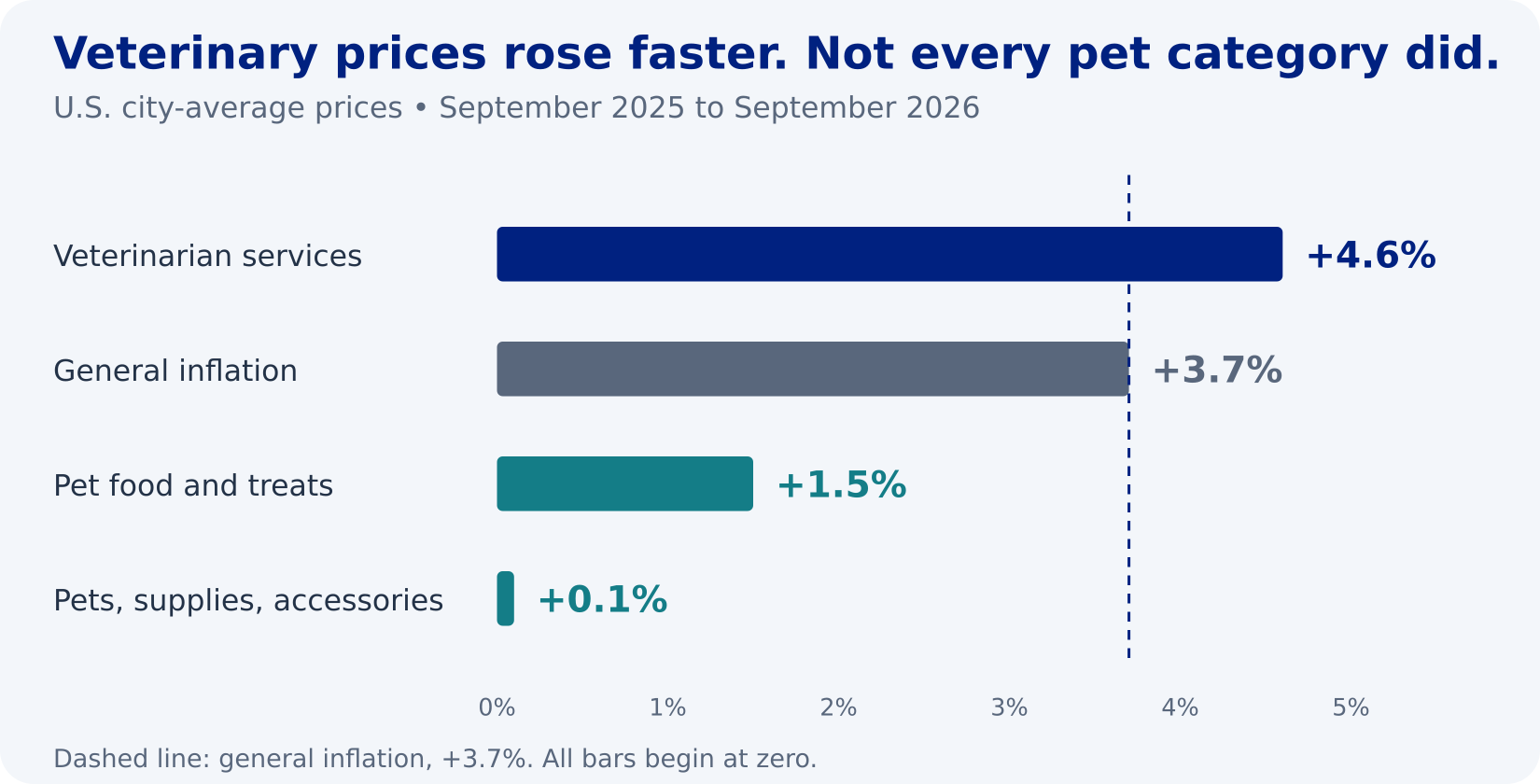
Consider this matched comparison from the Bureau of Labor Statistics. All four figures measure U.S. city-average consumer-price changes over the same period, September 2025 to September 2026:
View the figures as a table
| Price category | 12-month change |
|---|---|
| Veterinarian services | +4.6% |
| General inflation (all items) | +3.7% |
| Pet food and treats | +1.5% |
| Pets, supplies and accessories | +0.1% |
U.S. city-average CPI-U; September 2025–September 2026; unadjusted changes.
Source: U.S. Bureau of Labor Statistics, September 2026 CPI-U release, table 2; U.S. city average, unadjusted change from September 2025. General inflation means the all-items index. These are price changes, not household spending.
Veterinary-service prices rose 0.9 percentage points faster than general inflation in this comparison: 4.6% versus 3.7%. Food and supplies rose more slowly. The benchmark matters because “pet prices are rising” does not tell you which part of your budget is changing fastest. These indexes measure price change, not the cost of every animal’s care.
A second appointment or a new medication can therefore raise your spending even when a clinic’s prices stay unchanged. Conversely, finishing a course of treatment can reduce your spending while prices elsewhere rise. Applying one inflation percentage to everything misses both possibilities.
Lifetime estimates add another assumption: how many years are being counted. Synchrony’s 2025 study estimated $22,125–$60,602 for a dog and $20,073–$47,106 for a cat over 15 years. Fifteen years is the study’s chosen horizon, not a promised lifespan for a particular animal.
A lifetime total can be sobering, but you are also seeing many years of meals, ordinary care and life together added into one number. A lower annual cost sustained over more years can still produce a substantial commitment. The practical lesson is to revisit the estimate as that life unfolds: a move, a diagnosis, a new work schedule or a different care arrangement can matter more than simply adding another year of inflation.
Where insurance fits—and what it adds
Once you understand the costs, insurance becomes easier to evaluate. Pet insurance is an optional contract under which you pay a premium and the insurer pays part of eligible care according to the policy. It can help with a large covered bill, but the premium is an additional expense even in a healthy year.
A quoted monthly premium becomes a regular bill alongside food and other care. Compare that commitment with the protection actually offered, rather than assuming insurance is simply another routine expense every owner must buy.
The main terms describe how the bill is shared. A deductible is an amount you pay toward eligible care before the relevant insurance benefit applies. The reimbursement rate is the covered share, calculated according to the contract. A limit caps what the insurer pays over a specified period or for a specified benefit. Exclusions identify care it will not cover, and waiting periods can delay when coverage begins.
Some plans use a benefit schedule: a list of specified payments or maximum allowances for particular conditions or services, rather than simply paying a percentage of your veterinarian’s bill. The National Association of Insurance Commissioners explains these differences. Ask the insurer to show what its method would pay on an example invoice.
The details change the result. An annual deductible and a deductible for each condition behave differently if a pet has several problems. The Pets Best Alabama sample accident-and-illness policy uses an annual structure; Trupanion’s published 2019 sample policy describes a deductible per condition. These are example contracts to illustrate the distinction. The policy offered to you determines the calculation order and eligible charges—including whether “80% reimbursement” means anything close to 80% of the entire invoice.
Preexisting conditions can include earlier symptoms, advice or treatment—not only a diagnosis. The Pets Best sample also protects covered conditions from becoming preexisting on renewal. Starting a new policy is different: an existing problem may be excluded.
If you are used to a human health plan paying a provider directly and leaving you a copay or later bill, pet insurance can feel unfamiliar at checkout. Most pet policies reimburse the owner, so you may need to pay the veterinarian first and submit a claim afterward. That can require enough savings or available credit to cover the upfront charge—even when part of it will later be reimbursed. Borrowing to bridge that gap adds its own repayment obligations. Ask whether direct payment is available for your appointment, what documents are needed and when payment can be expected.
There is another important difference: human health plans sold through the Marketplace must cover preexisting conditions. Pet insurance does not carry that same general protection. A familiar word—“insurance”—can describe very different rules.
Renewal deserves attention too
Renewal does not necessarily mean the same premium. Trupanion’s sample allows price changes with notice. Pets Best’s sample renews annually with current payments and says individual claims do not change the premium. These protections depend on the contract.
Nonrenewal is a real issue to investigate, too. In 2024, Nationwide announced plans to nonrenew about 100,000 pet policies through summer 2025, as reported by the Kansas City Veterinary Medical Association. The report said the company attributed the action to business and cost pressures, rather than an individual pet’s age, breed or prior claims. This historical announcement does not establish how commonly nonrenewal occurs across insurers.
Before choosing or replacing coverage, ask what renewal protections apply, how prices can change and how a new insurer would treat the animal’s existing history. Compare continuity of coverage as well as the next monthly payment.
Wellness plans are a different purchase
You do not have to buy pet insurance to use every kind of wellness plan. A veterinary practice can sell a standalone package of preventive services; an insurer may offer routine-care benefits only as an add-on to an insurance policy. The name alone does not tell you which arrangement you are buying.
Banfield’s Optimum Wellness Plans are standalone annual preventive-care packages, not insurance. Monthly payments spread an annual commitment; early cancellation can leave an amount due for services already used. Its renewal arrangements also differ between monthly and annual payment plans.
Pets Best’s routine-care benefits, by contrast, are optional additions to its insurance coverage. They reimburse listed preventive services up to separate stated amounts. Adding the benefit does not make every preventive bill disappear.
Compare the services your pet is likely to need, the amounts or visits included, where they can be used, and the cancellation and renewal terms. Check overlaps before paying for two packages. When adding up ownership costs, count the package price and remaining uncovered charges, rather than adding the full price of included services again.
Convenience can have value, too: a package that helps you keep up with recommended care may be worth a modest extra cost, provided the annual commitment fits your budget.
When the bill is bigger than you expected
Even a carefully considered estimate can be overtaken by events. That is the point to bring together the resources available: money already set aside, any applicable coverage, the care options discussed with the veterinarian and possible outside assistance. Savings can meet expenses without a claim decision; insurance can transfer part of an eligible bill; borrowing can bridge a timing gap when its repayments are affordable. Each addresses a different part of the problem.
Savings bring flexibility, but keeping the money available takes follow-through. A skipped transfer or a withdrawal for something else changes what you can actually pay. Give the fund a clear purpose and a manageable routine; our monthly savings guide explains how to restart when life interrupts it.
Borrowing can help spread a bill over time, but the repayment terms deserve the same attention as the treatment estimate. Two offers that sound similar can behave very differently:
- Deferred interest: interest is calculated from the purchase date but is waived if you pay the promotional balance in full by the deadline and meet the offer’s conditions. Leave a balance, and that earlier interest can become payable.
- A genuine 0% APR period: the interest rate is zero during the stated period. A balance remaining afterward can begin accruing interest at the applicable rate, without adding interest retroactively for the zero-rate period.
APR means annual percentage rate—the yearly interest rate used to calculate borrowing charges. The Consumer Financial Protection Bureau’s comparison explains why “no interest if paid in full” and “0% APR” are different offers.
CareCredit offers deferred-interest promotions where available. Its March 2026 posted account agreement lists a 32.99% purchase APR; your account agreement and the particular offer determine your terms. A provider may offer different promotions, so confirm the one attached to your purchase.
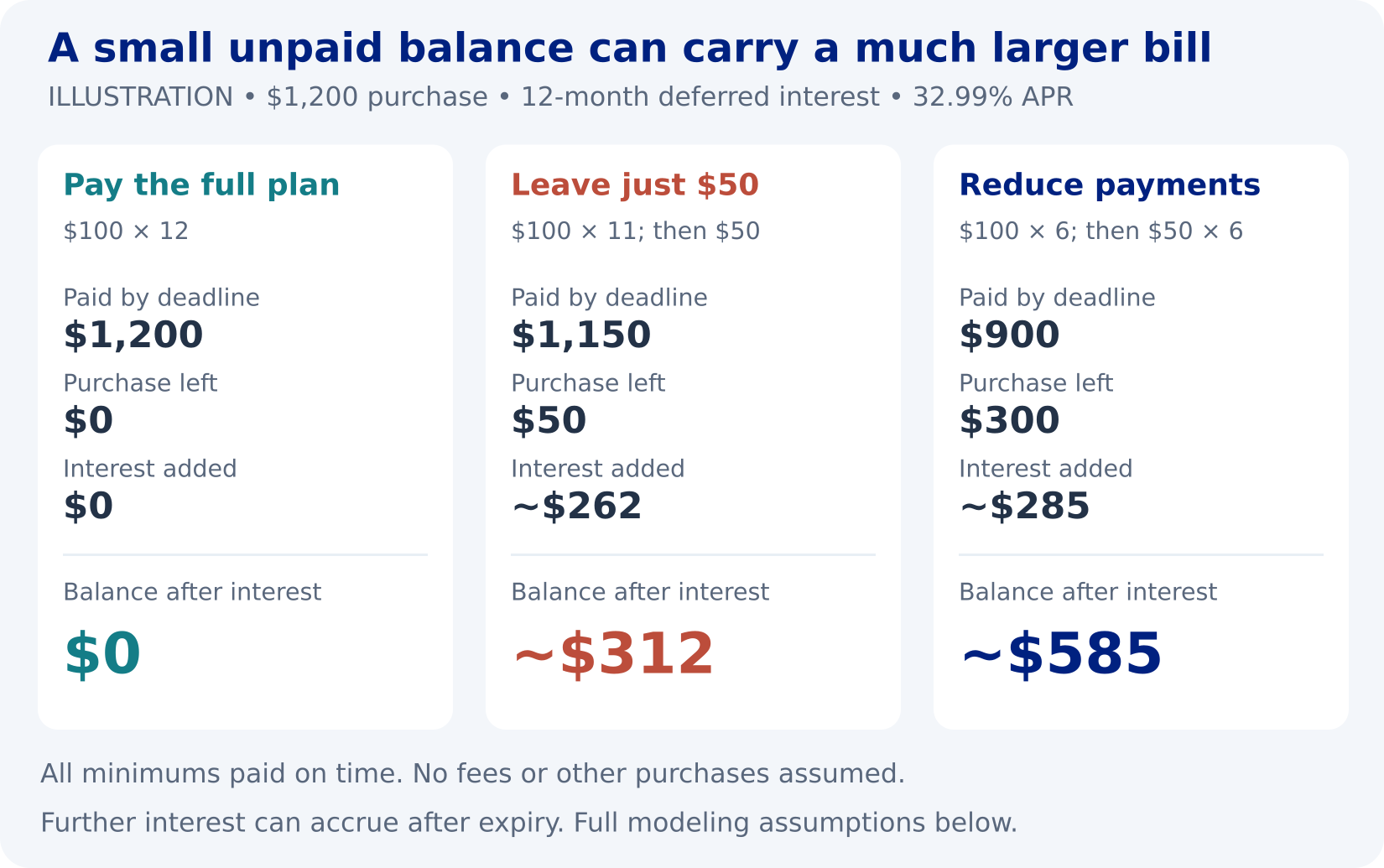
Illustration: one $1,200 purchase, three ways a 12-month deferred-interest offer can end. The example uses the posted 32.99% purchase APR and daily-interest method. All required minimum payments are assumed to arrive on time; there are no other purchases or fees. The difference is whether the planned payoff is completed.
View the figures as a table
| Payments | Paid before deadline | Purchase balance left | Added deferred interest | Balance after deadline |
|---|---|---|---|---|
| $100 × 12 | $1,200 | $0 | $0 | $0 |
| $100 × 11; then $50 | $1,150 | $50 | About $262 | About $312 |
| $100 × 6; then $50 × 6 | $900 | $300 | About $285 | About $585 |
Invented 12-month deferred-interest example at 32.99% APR. All required minimum payments are assumed on time; no other purchases or fees. See the full assumptions below.
Educational model, not a customer statement. Purchase on day 1; payments every 30 days through day 360; promotion ends after day 365. Daily rate 0.09039%, compounded daily; payments reduce the balance before that day’s interest. Rounded results exclude fees and further interest after expiry. Actual dates, allocation and offer terms change the result. Sources: CareCredit agreement and CFPB explanation.
The surprise is that $50 left can become roughly $312 owed. The added interest reflects earlier balances, not just the last $50. In that middle example, payments already made plus the new balance total about $1,462. It can cost more if repayment continues afterward. With a genuine 0% APR offer, that earlier zero-rate period would not acquire interest retroactively.
The last example shows a different squeeze: the household keeps paying, but reduces its planned payment halfway through. It reaches the deadline with $900 paid and roughly $585 still owed once interest is added. Missing required minimum payments is a separate problem: late fees can apply, and the posted agreement describes a possible 39.99% penalty APR on new transactions after two or more late minimum payments within 12 billing cycles.
For a sense of that higher rate, suppose a new $1,200 purchase began at 39.99% and otherwise followed the middle example’s promotional terms and payment schedule. The final $50 would be joined by about $334 in deferred interest, leaving roughly $384 owed instead of $312, before fees or further interest. This assumes the penalty rate already applied when the new purchase was made; it does not retrospectively change the original example’s 32.99% rate.
This is the part of the offer that deserves plain language. An affordable minimum payment does not necessarily make the full repayment plan affordable. The concern is not hypothetical: in a 2013 enforcement action, the Consumer Financial Protection Bureau ordered GE Capital Retail Bank and CareCredit to provide up to $34.1 million in refunds over deceptive enrollment practices, including consumers being led to believe the card was interest-free. That historical action does not establish misconduct in every current offer; it explains why clear terms matter at a stressful moment.
For the $1,200 example, twelve payments of $100 work only if they reach that purchase balance before the promotional deadline. Other balances can change where a payment goes: the CFPB explains payment-allocation rules, including special treatment near the end of a deferred-interest period.
Before accepting, get the exact payoff date, the payment needed to finish in time, and confirmation of how it will be allocated. Compare that schedule with what you can sustain if another bill arrives. If the plan stops fitting, contact the issuer before the deadline and ask about options. Used successfully, deferred interest can avoid interest altogether; the goal is to understand both possible outcomes before committing.
Help can come from outside the household
There are other places to turn, including nonprofit grants, community services and crowdfunding. They help in different ways, so start with the gap you are trying to close.
For a medical funding gap, try a nonprofit assistance program. RedRover’s Urgent Care grants typically contribute about $250–$300 toward eligible urgent treatment. They require a veterinarian’s diagnosis, treatment plan and estimate, and do not cover the initial exam, testing or ongoing treatment. Check the full eligibility rules; the program is designed for small gaps, not an entire large bill.
For help closer to home, ask about local services. A shelter, rescue or veterinary practice may know about a pet-food pantry, a lower-cost clinic or a charitable fund. RedRover’s resource guide gathers places to start. A useful first call explains the pet’s need, your location and the amount or service you are seeking.
For help from your community, consider crowdfunding. This means inviting people to contribute to a specific need. Before choosing a platform, check fees, who receives the money, when it becomes available and what happens if treatment changes. Share an accurate estimate and updates, with private information removed.
An application or campaign is a request for help, not confirmed money. Ask the veterinary team what needs to happen now and whether it is safe to wait; urgent care should not be postponed for an uncertain fundraising result. Needing assistance does not erase the care you have already given your pet. It means bringing more people and resources into the effort.
Find the version of pet care that works for you
Planning can have a satisfying side: trying out choices before you are committed to them. You might discover that the food your veterinarian recommends is comfortably within reach, that family can cover one workday, or that paying for a reliable sitter is the convenience you value most.
Start with what your pet needs, then explore suitable ways of meeting those needs. A simple setup may do the job beautifully. A paid service may be worth protecting in the budget because it makes daily life workable. Optional upgrades can wait. Medical needs deserve a conversation about appropriate options, rather than being treated like features to remove from a shopping cart.
Bring three questions to the next useful conversation:
- What does my pet need now, and what is likely to come next?
- Which suitable options fit our money, time and ability to provide care?
- If the plan changes, whom can I call and what help could be available?
For the calendar side, the consumer bureau’s free bill calendar is a simple place to start. Our guides to monthly dog costs, monthly cat costs and monthly savings develop the next steps without expecting you to work out everything today.
When a pet becomes ill, the worry can reach well beyond the bill. Having records, contacts and some decisions already discussed gives you fewer things to arrange in the middle of it. It cannot remove every hard choice, but it can help you face one with more information and support.
Your budget is a resource for care, not a score of your affection. The goal is a sustainable life together: thoughtful attention to what the animal needs, honest conversations when resources are tight, and plenty of ordinary days to enjoy each other.
Can’t I just ask ChatGPT?
After thinking through food, care, workdays and all those “what ifs,” it is natural to want some help putting the picture together. Research-enabled AI can help explain unfamiliar terms, find sources, calculate comparisons and work with details about your pet. A spreadsheet can help too.
The challenge is not just getting an answer. Pet-cost information comes in pieces: an older national spending survey, a local quote, a study of a particular breed, and a bill for your own animal. Those pieces describe different things. A useful estimate needs to keep the dates, assumptions and your pet’s circumstances connected, then be revisited as they change.
A one-off answer will not do that work by itself. Well-used AI can contribute to an ongoing plan, just as a dedicated planning tool can make it easier to return to the same information. The test is whether you can understand the estimate, see what it includes and update it when real life adds something new.
No tool needs perfect foresight to be useful. There is room to make planning more relevant and easier to maintain without pretending the next illness is knowable. Start with a useful picture, improve it as you learn, and keep room for the pet—and the life—that no average can fully describe.
Study estimates and historical prices are not current local quotes. The public owner accounts are self-reported and unverified. Product terms and individual care needs vary.
By PetHSA Editorial Team